
















































Absolute Return Strategy
An investment strategy aims to generate positive returns in both up markets and down markets. They are contrasted with investment strategies that aim to beat an investment index or peer group – these can still be considered successful if they deliver a negative return that beats this target. Absolute return strategies aim to always deliver a positive return.
Accruals
Accruals are non-cash earned revenues and incurred expenses that impact the income statement but are not yet reflected into cash movements. They also affect the balance sheet, via liabilities and non-cash-based assets used in accrual-based accounting. These accounts include, among others, accounts payable, accounts receivable, goodwill, future tax liabilities and future interest expenses. Although accrual accounting has the advantage of encompassing forward elements of the activity, it also leaves room for accounting abuse or analysis bias. Accruals over Assets can then be used as a proxy for earnings quality and are calculated as follows:
Accruals over Assets = (Net Income – CFO) / Total Assets
Please note that this calculation does not apply for financials given that virtually no cash flow is retained.
Active Investment
An investment approach where an investor makes positive decisions about which securities to invest in, based on in-depth research, market forecasting and the expertise of the management team. It is usually contrasted with passive management, where an investor invests in line with market movements, without making any active investment decisions.
Alpha
In simple terms, alpha represents the value that an investment manager adds – or subtracts – beyond just following the market trends. It shows whether an investment strategy has outperformed or underperformed the market after accounting for risk. Positive alpha means the investment has done better than expected, delivering higher returns than the market would suggest; Negative alpha indicates it has performed worse than the market. It is usually expressed as a percentage: an alpha of 1.00 indicates that a fund has outperformed its benchmark by 1%.
Alternative Investment
Investments considered outside of the traditional asset classes of stocks, bonds and cash. This includes things like real estate, commodities, options and financial derivatives. Hedge funds often invest in alternative assets as a way of delivering returns that are uncorrelated to the traditional investment assets.
Alternative Investment Market (AIM)
A part of the London Stock Exchange (LSE), with an associated index. This is a market for where smaller, growing firms can list and enjoy more regulatory flexibility than the main London Stock Market.
Annual management charge (AMC)
A fee charged by fund managers to investors to cover costs of the day-to-day management of an investment portfolio. It is usually based on a percentage of the investors assets in the fund. A fund’s stated AMC doesn’t cover all the costs, and there may be additional charges on top of this.
AMCs can vary between funds, Investors should consider the impact of fees on their investment, while also considering that the cheapest is not always the best.
Annuity
An annuity is a financial product that provides a guaranteed income in exchanges for a set amount. They are typically used by people retiring to provide an income for the rest of their life.
Anti-dilution levy
This liquidity management tool is a fee that is paid to the fund by a unit-holder or shareholder at the time of a subscription, repurchase or redemption of units or shares, that compensates the fund for the cost of liquidity incurred because of the size of that transaction, and that ensures that other unit-holders or shareholders are not unfairly disadvantaged.
Arbitrage
Arbitrage usually refers to a financial strategy designed to profit from a discrepancy in the market. The arbitrage opportunity occurs when short term pricing inefficiencies are detected. A typical arbitrage would be to simultaneously buy and sell similar financial instruments in different markets to capture an abnormal price difference.
Ask / Bid price
The lowest price a seller is willing to sell a security for / against the highest price a buyer is willing to pay for a security.
Asset Allocation
The broad name for the process of balancing the risk and rewards from different investments and deciding how much to invest in different assets. Asset allocation decisions will depend on an investor’s tolerance for risk, their particular goals and their investment time frame. Asset allocations can be adjusted over time in response to information that affects the value of different assets or in line with an investor’s goals.
Asset Backed Security (ABS)
Asset Backed Securities (ABS) are a type of bond which is backed by specific assets as collateral. The collateral typically used to back ABS include: auto loans, credit card receivables, housing loans or student loans.
Authorised Corporate Director (ACD)
In the UK, this is the specific legal term for a company authorised and regulated by the Financial Conduct Authority and given powers and duties under Financial Conduct Authority regulations to operate an OEIC. BNP PAM is the authorised corporate director of the OEICs we offer to investors.
Backwardation
Backwardation refers to a market condition where the forward price of a contract trades below its spot price. In other words, backwardation is a situation where the tradeable price curve of an instrument is inverted (when the short term price is higher than the forward price). The opposite market condition to backwardation is contango.
Bear market
A market where an index has endured a prolonged fall and is anticipated to drop further still. Pessimism and negative sentiment tend to be characteristics of such a market. If a market falls 20%, it is considered to be a bear market.
The opposite scenario, where markets experience a sustained rise, is known as a “bull market”.
Behavioural finance
Behavioural finance is a theory which argues that due to psychology-based biases, efficient-market hypothesis is not applicable. The proponents of behavioural finance, emotionality and lack of rationality of some investors explain market anomalies.
Benchmark
A benchmark refers to an index representing the market or markets that an investment strategy invests in. It is a way for investors to understand the range of assets the fund is likely to invest in, although the fund’s investment approach may allow it to invest a proportion of assets outside this index.
Some fund managers measure their performance against a benchmark. For example, a UK equity fund manager may benchmark their investment performance, against the FTSE All Share. This can help investors decide whether a particular investment strategy is right for them.
Beta
Beta measures the sensitivity of an investment strategy to the market. A beta of 1.10 suggest the fund could perform 10% better than the benchmark in up markets and 10% worse in down markets, assuming all other factors remain constant
Bid-to-cover ratio
The bid-to-cover ratio is an indicator used in an auction process to assess the strength of the demand for an asset. It is calculated as the number of suitable bids received divided by the number of bids accepted (the total value of bids can also be used). The higher the ratio (above 2), the more successful the auction. The opposite: a low auction ratio, signifies a disappointing auction.
Bid/offer price
The highest price a buyer is willing to pay for a security versus the lowest price a buyer is willing to accept. Some investment funds have a higher cost for buying, for example because they have an initial charge.
Blue Chip
A colloquial term for shares in large companies with a strong credit rating.
Bond
A bond is a fixed-term loan that can be traded between investors. Bonds are issued by governments or companies when they want to raise money, but don’t want to issue more shares. Essentially, it’s an IOU, with a fixed term and regular interest payments at a rate set when the bond is issued (these payments are often called the coupon). When the term ends the issuer repays the original loan – the principal – to the bondholder.
You can find out more about investing in bonds here: https://www.bnpparibas-am.com/en-gb/capabilities/individual-investors/investing-in-bonds/
Bond Maturity
A bond “matures” when the term ends and the issuer of the bond repays the original amount loaned to the bond holder. A bond’s maturity date is usually set when it is issued.
Bond Ratings
An assessment of a bond issuer’s creditworthiness, indicating the likelihood that the issuer will meet its debt obligations. Bond ratings help investors evaluate the risk associated with a particular bond before investing. Bond ratings are based on an analysis of the issuer’s financial health, including factors such as income, debt levels, cash flow, and overall financial stability. They are provided by specialized credit rating agencies that evaluate the issuer’s ability to repay principal and interest.
The main providers of bond ratings are:
- Standard & Poor’s (S&P)
- Moody’s Investors Service
- Fitch Ratings
The highest rating is AAA, and the lowest is D. Bonds rated between AAA and BBB – are known as investment grade bonds and are considered more secure. Bonds with a lower ratings are considered less secure.
Bonds are typically categorised into different tiers:
- Investment Grade: Bonds rated BBB- or equivalent and above. These are considered to have low to moderate credit risk and are suitable for conservative investors.
- High Yield: Bonds rated BB+ or equivalent, indicating a higher risk of default but with the potential for higher returns.
- Junk Bonds: Bonds rated below investment grade (e.g., BB+ and below), which carry significant default risk and are suitable mainly for investors willing to accept higher risk for the possibility of higher yields.
Bond yield
Bond yields represent the return an investor can expect to earn from holding a bond. In simple terms, it’s the interest rate you get compared to the price you pay for the bond.
Bond prices change as investors adjust their expectations based on interest rates, economic outlook, and the issuer’s credit risk. This causes bond yields to change as well.
Rising bond yields mean that bond prices are falling – investors are demanding higher returns to compensate for increased risk, or changes in the market mean they less interested in holding bonds. Conversely, falling bond yields mean that bond prices are rising, because bonds are less risky or more popular.
Bottom-up
An investment approach based on analysing individual companies based solely on their investment quality and potential, regardless of their wider industry and the macro-economic backdrop. See also ‘Top-down’, which bases investment decisions on external factors
Brent crude
Brent crude is one of the main measures of oil prices. It is the price of sweet light crude oil sourced from the North Sea. Brent crude oil is also called Brent Blend, London Brent or Brent petroleum.
BRICs
Acronym for four of the largest emerging market economies, Brazil, Russia, India and China.
Broker
Such as a stockbroker or insurance broker – a person or firm, which executes buy and sell orders on behalf of investors. Brokers make their money via commissions from their trades.
Bull market
A market where the value of securities such as shares or bonds have risen markedly. It is characterised by optimism, investor confidence and expectations of further rise. Generally speaking, a sustained 20% market rise would be considered to be a bull market.
The opposite scenario, where markets experience a sustained loss, is known as a “bear market”.
Butterfly
A butterfly is an option strategy generally implemented when the future volatility of an underlying is expected to be different from its implied volatility. A long butterfly strategy will generate a profit if the underlying shows price stability, while limiting downside risk during adverse market movements. This strategy could be constructed by selling a call and a put at-the-money (see straddle definition for further details) and simultaneously buying a put and a call option both out-of-the-money.
C-VaR
Conditional value at risk (C-VaR) is a measure of risk that gives an amount of potential loss a portfolio can suffer should the VaR be exceeded. It is associated with a confidence level (x %) and a time horizon (number of days) and is calculated as the weighted average between the value at risk and losses exceeding that value at risk. For instance, a C-VaR (95%, 5 days) of EUR 1 mn means that in 5% of the cases, the portfolio could lose an average amount of EUR 1 mn over a period of 5 days. C-VaR is also known as “expected shortfall” or “tail VaR”.
Call option
See ‘Option’
Cap
An interest rate cap is a derivative contract in which the buyer pays a fee (premium) to receive payments at the end of each defined period when the interest rate used as a reference exceeds a pre-agreed level (the strike price). For instance, an agreement to receive a payment every six months for the next three years when the six-month EURIBOR rate exceeds 1% is a three year cap strike of 1% on 6 month EURIBOR.
Capital expenditure (CAPEX)
Capital expenditure (CAPEX) is the overall term for the money a company spends investing in its business. This covers things like the expense of buying new equipment, property for new factories or retail outlets, or updating and improving existing equipment.
Capitalisation
A broad measure of how much a company is worth. It is calculated by adding up the value of all a company’s shares. Investors often talk about small, medium and large-cap companies as this can be a useful way of thinking about how big a company is. Large-cap companies tend to be big multinationals, while small-cap companies tend to be smaller and focused on domestic markets. Mid-cap companies sit between these extremes and can have characteristics of both. The exact boundaries of these terms is different in different markets, where the size of companies can vary, and will change over time.
Carbon Credits
Carbon credits are a way for businesses and individuals to offset their carbon emissions. They work by buying credits from projects that reduce or remove greenhouse gases, such as reforestation or renewable energy initiatives.
Carbon Emissions - Scope 1, 2, 3
Carbon emissions are the release of gases like carbon dioxide and others into the air, mostly due to human activities like burning coal, oil, and gas for power and transportation. Emissions are often broken down into three categories:
Scope 1 emissions are direct emissions, such as burning fuel in company vehicles or from on-site generators.
Scope 2 emissions are indirect emissions resulting from the purchase of electricity, steam, heat, or cooling used by a company or organization.
Scope 3 emissions are all other indirect emissions, such as emissions from transportation of goods, employee commuting, and the production of purchased materials.
Carry
The return derived from holding a bond over time. For instance, the three-month carry of a bond corresponds to the gain or loss an investor will record by carrying the bond for three months. The carry is usually expressed in basis points.
Cash and carry
A cash and carry trade is a transaction usually considered to be a type of arbitrage. In this transaction, an investor buys an asset while selling the future contract on the same asset for a given forward expiry date. Taking into account the cost associated with purchasing and keeping the asset until the expiry date of the future (borrowing the asset, storage for a commodity etc.), the investor will perform this arbitrage if the forward price of the asset derived from the spot price and the costs associated is lower than the future price of the asset.
Central Banks
A central bank plays a key role in managing a country’s economy. For retail investors, its main duties include:
- Controlling interest rates: The central bank sets key rates to influence borrowing and lending, which affects overall economic activity.
- Managing inflation: It aims to keep inflation at a stable, healthy level to protect the value of money.
- Ensuring financial stability: The central bank oversees the banking system to prevent crises and maintain confidence.
This is important to investors because the central bank’s action influence interest rates, inflation, and overall economic health. These factors affect investment returns, bond prices, stock markets, and the value of money, helping investors make informed decisions.
CFROI
Means Cash Flow Return On Investment.
Changes in Working Capital
Changes in Working Capital are reported in the cash flow statement.
Cheapest to deliver
The cheapest to deliver (CTD) terminology is used in futures markets and corresponds to the least expensive underlying product that can be delivered on the expiry date of the futures contract. In most futures contracts, sellers (investors who are “short” on the future) have the right to deliver different types of underlying and therefore will always want to deliver the cheapest available underlying. The price of the derivative contract will then take into account the CTD price of the underlying.
Closed-ended fund
A mutual fund with a fixed number of units, as opposed to open-ended funds where additional units can be created by fund managers to meet investor demand. The units of closed-end funds can be bought or sold in the market. See also ‘Open-ended fund’
Collar
A collar is a combination of the purchase (sale) of a cap and the sale (purchase) of a floor. It protects a floating rate borrower (lender) from an increase (decrease) in interest rates. For instance, a floating rate borrower will buy a cap and sell a floor (at a lower strike price). The cost of the collar will then be lower than the cost of a cap due to the proceeds of the sale of the floor (it can even be a zero cost collar when the cap and the floor trade at the same price). In exchange for the reduced price, the borrower’s gain will be limited if there is a decrease in interest rates.
Collateralised Debt Obligation (CDO)
Collateralized Debt Obligations (CDOs) are complex financial products that pool together various types of debt, such as loans or bonds, and then divide this pool into different slices or tranches. Each tranche has a different level of risk and return, allowing investors to choose based on their risk appetite.
Investors can use CDOs to diversify their holdings, tailor their risk exposure, or seek higher returns. They can be part of a broader fixed-income or alternative investment strategy, but due to their complexity, they are generally suited for more experienced investors or institutional portfolios
Collective investment schemes
A general term encompassing authorised unit trusts, common investment funds, OEICs and investment trusts.
Commodities
Natural resources and raw materials from oil to gold. Includes ‘hard’ commodities such as industrial and precious metals, as well as ‘soft’ commodities such as agricultural produce including coffee and wheat.
Constant Proportion Portfolio Insurance (CPPI)
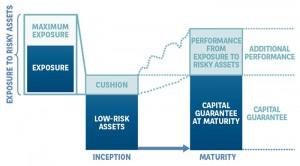
A Constant Proportion Portfolio Insurance (CPPI) is a trading strategy or portfolio construction technique which allows an investor to maintain exposure to the upside potential of a risky asset while providing protection (or a capital guarantee) against downside risk.
Consumer Price Index (CPI)
The Consumer Prices Index (CPI) tracks the price of a basket of goods chosen to reflect the actual consumption of a typical consumer. It shows how prices are changing over time. The variation in CPI is a measure of the rate of inflation – this is called Consumer Price Inflation.
Contango
Contango refers to a market condition where the forward price of a contract trades above its spot price. In other words, contango is a situation where the tradeable price curve of an instrument is normal (the short term price is lower than the forward price). The opposite market condition to contango is backwardation.
Convertible bond
A convertible bond is a bond that gives its holder the right to convert it into the issuer company’s shares according to a conversion ratio. With both features of bonds and equities, convertible bonds are classified as hybrid instruments.
Convexity
The convexity is a measure of change in duration when interest rates move. In general, bonds have a positive convexity.
Corporate bonds
A bond issued by a corporation to an investor as a means of raising money.
Counterparty risk
Counterparty risk refers to the risk that a counterparty of a financial transaction will not honour its contractual obligation. For investors, this is mainly the risk that the counterparty in an investment transaction will default before the transaction is processed.
Coupon
The regular interest paid by a bond. It is calculated based on the face value of the bond when it was issued and the bond’s interest rate
Covered bond
A covered bond is a bond backed by a pool of loans. If there is a default by the covered bond issuer, this pool of assets is used to repay the covered bond. By definition, this type of bond is safer than a senior unsecured bond.
Credit default swap (CDS)
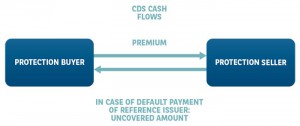
A CDS is like an insurance contract against the chance that a credit instrument – like a bond or a loan – won’t be honoured. In exchange for regular payments, the buyer of protection will be paid back by the party providing the cover in case of a “credit event”. Credit events usually includes things like the issuer of the debt defaulting, going bankrupt or restructuring its debt.
Credit event
See Bond Rating
Credit ratings and credit risk
An assessment of a bond’s security, given by an independent ratings company such as Standard & Poor’s. The highest rating is AAA, and the lowest is D. Bonds rated between AAA and BBB – are known as investment grade bonds and are considered more secure. Bonds with a lower rating are considered less secure.
Credit spread
A credit spread measures the credit risk premium of a debt issuer. It’s the difference in interest rates between two types of loans or bonds — typically, between a safer, high-quality bond (like government bonds) and a riskier one (like a company’s bond).
The width of the spread represents how much investors expect to get paid in return for taking additional risk. The wider the spread, the more investors are demanding to compensate for higher risk; the narrower it is, the more confident they are about the safety of the riskier bond
Custodian
A custodian is a financial institution responsible for holding and safeguarding financial assets for a third party. They are a crucial part of the legal structure of collective investment schemes like OEICs and unit trusts. All the securities and cash are help securely by a custodian, who makes sure that everything is recorded correctly, and handling the paperwork when buying or selling assets. This ensures that investor’s money is protected, kept safe, and managed properly.
Cyclical Sector
A cyclical sector is made of companies whose business is closely linked to the macroeconomic cycle. They will typically do better when the economy is healthy and suffer during an economic downturn. Cyclical sectors include automobiles, chemicals, steel & mining and advertising. They are contrasted with non-cyclical sectors, whose fortunes are less closely tied to the economic cycle.
Decarbonisation
Reducing carbon emissions to help stop climate change. This involves doing things like switching from using fossil fuels (like coal and oil) to cleaner energy sources (like wind and solar power) and finding ways to capture and store carbon.
Default
Failure to pay interest or principal on a bond when due. Default occurs when a debtor is unable to meet the legal obligation of debt repayment.
Deflation
See inflation.
Delta
Delta measures the change in value of a derivative from a change in the price of the underlying asset. It is sometimes referred to as the “hedge ratio”.
Depositary
The depositary is a firm (usually a bank) authorised by the FCA and independent of the OEIC and its directors. It has legal title to the OEIC investments, is responsible for their safe custody and ensuring the OEIC complies with key regulatory requirements.
Derivative
A derivative is a financial instrument whose value depends on the value of an underlying asset. This could be stocks, bonds, interest rates, commodities or currency. The main types of derivative are options, swaps, forwards and futures.
Derivatives give investment managers flexibility to efficiently manage exposure to different types of risk, including leveraged exposure, short exposure or even customised exposure (with the use of options). However, they can lead to greater fluctuations of a portfolio’s value than investing directly.
Derivatives are often used to ‘hedge’ risks. See also ‘Hedging’
Discount
Usually refers to an investment trust trading in a range less than its net asset value. As investment trusts are traded as shares on the stock exchange, their share price can fluctuate, based on demand. If a trust is in great demand, its shares can trade at a premium i.e. at a great value than their actual net worth.
Distribution/Distribution shares
Shares or unit in a fund where income can be paid to investors rather than added to an investor’s holding. This income is known as the Distribution. Also known as ‘Income shares’.
Dividends
A dividend is a share of a company’s profit that is paid out to shareholders. It is usually paid either quarterly, twice a year or annually.
Drawdown
The difference between the highest price and lowest price of an asset during a specific period, usually quoted as a percentage. Not to be confused with pension drawdown.
Dual pricing
With this liquidity management mechanism the subscription, repurchase and redemption prices of the units or shares of an investment fund are set by adjusting the net asset value per unit or share by a factor that reflects the cost of liquidity.
Duration
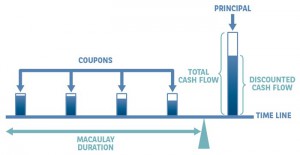
A measure of the extent to which the value of a bond will be affected by changes in interest rates expressed as a number of years. It is calculated based on both a bond’s yield and years to maturity to show. As a general rule, the higher a bond’s duration, the greater the price volatility which results from interest rate movements.
Modified duration estimates how much the price of a bond will change when interest rates move. It shows the percentage change in the bond’s price for a 1% change in interest rates. Modified duration helps investors understand the interest rate risk of a bond, indicating how sensitive its price is to changes in market interest rates.
Effective duration estimates the sensitivity of a bond’s price to changes in its benchmark interest rates. Effective duration is required for the measurement of interest rate risk for complex types of bonds.
Effective Duration
See ‘Duration’.
Efficient-market hypothesis (EMH)
The efficient-market hypothesis asserts that information is efficiently reflected in asset prices. Three forms of efficiency are identified:
- Strong form: in its strong form, all information (including private information) is integrated intothe prices.
- Semi-strong form: in this form, all public information is integrated into the price.
- Weak form: in the weak form, past prices do not reveal any information on future prices.
Emerging markets
A country with an economy that is still growing and developing quickly, but isn’t as big or stable as the economies of more established countries like the US, Japan or Germany. Emerging markets can offer good opportunities for growth, but they can also be more affected by economic changes or political issues.
Equities / stocks / shares
A stock or any other security representing an ownership interest
Equity
Another name for a share in a company. Shares are often called ‘equity’ as they represent the value of a company divided into equal parts. In theory, if a company was wound up and all its interests and property were sold off then the outcome would be shared between all the shareholders, based on how many shares they hold.
You can find out more about investing shares here:
https://www.bnpparibas-am.com/en-gb/capabilities/individual-investors/investing-in-shares/
Excess Returns
See ‘Alpha’
Exchange traded fund (ETF)
Exchange-traded funds (ETFs) are funds traded on the stock exchange. ETFs can invest in stocks, bonds or commodities. They generally track market indices (such as the MSCI), offering investors access to diversified and passive liquid portfolios at low cost.
Exposure
Describes the level of risk that a portfolio holds to a particular asset, asset type, sector, market or government.
It can also mean the directional market exposure of a fund with an absolute return focus.
Extension of notice periods
The extension of notice periods is a liquidity management tool that extends the period of notice that unit-holders or shareholders must give to fund managers, beyond a minimum period which is appropriate to the fund, when redeeming their units or shares.
Financial Conduct Authority (FCA)
The FCA oversees and regulates financial firms providing services and products to UK consumers. It was formerly known as the Financial Services Authority.
Financial Services Compensation Scheme (FSCS)
The FSCS is a free service and the UK’s compensation scheme of last resort for customers dealing with authorised financial services firms. The organisation pays customers compensation if a company is unable to, usually as a result of going bust.
Fixed interest securities or Fixed income
Another term for bond-related investments.
See also ‘Bonds’
Float Shrink
A Float Shrink is a reduction in the number of a publicly traded company’s shares available for trading. Float Shrink can occur in a number of ways: through a buyback or repurchase of a company’s shares, an investor acquiring a large stake in a company or even through a reverse split or share consolidation. The term Float Shrink however, is most commonly associated with share buybacks. A Float Shrink achieved through a share buyback reduces the number of total shares outstanding for a company, which has a positive impact on Earnings per Share (EPS), Cash Flow per Share and Return on Equity.
Floating Rate Note (FRN)
A bond with a variable interest rate tied to a benchmark, such as LIBOR (London Interbank Offered Rate).
Floor
An interest rate floor is a derivative contract in which the buyer pays a fee (premium) to receive payments at the end of each defined period when the interest rate used as a reference is below a pre-agreed level (strike price). For instance, an agreement to receive a payment every six months for the next three years when the six month EURIBOR rate is below 1% is a three year floor strike of 1% on 6 month EURIBOR.
Forward rate agreement
A forward rate agreement (FRA) is generally an OTC contract between two counterparties agreeing on an interest rate to be applied to a forward loan. The FRA receiver thus accepts the contract, at a pre-determined interest rate, to lend money to the FRA payer at a future date. Generally, no loan will be extended, instead the FRA will be cash-settled at the forward date.
Forward
These are transactions where the buyer and seller agree on a price now for a delivery of a commodity or asset at a later date.
Fund
A pooled investment. Typically run by a fund manager who uses investors’ money to invest in a wide range of assets, such as stocks or bonds, following a determined strategy.
A fund can be a straight-forward way to invest in a portfolio of diversified assets.
You can learn more about investing in funds here:
https://www.bnpparibas-am.com/en-gb/capabilities/individual-investors/investing-in-a-fund/
Fund-of-funds
A fund that invests in a range of other funds, as opposed to individual stocks or securities. Sometimes known as a multi-manager fund.
Future
A future is a contract to buy or sell an underlying asset at a specified date and at a pre-defined price. It is a type of derivative. Unlike forwards which are generally over the counter transactions (OTCs), futures can be standardised contracts traded on exchanges.
Gilts
A name commonly used to mean UK government bonds. It is an abbreviated versions of ‘gilt edged securities’, referring to a time when bonds came as paper certificates with edges trimmed with gold.
Greeks
Greeks are sensitivities of derivative prices to all factors on which they depend (underlying price, maturity, volatility, risk free rate):
- (delta): sensitivity to underlying price.
- (theta): sensitivity to time to maturity.
- (vega): sensitivity to volatility.
- (rho): sensitivity to risk-free rate.
- (gamma): sensitivity of delta to the underlying price.
Derivatives are mainly used to hedge certain risks. Greeks indicate the inverse of the derivative quantity needed to optimally hedge targeted risks. For example, the purchase of 20 puts with a delta of -0.50, will hedge (against underlying movements) a long position of 10 underlying stocks.
Green bond
A bond that raises money for environmental projects. Investors get a return like regular bonds, but their money goes towards things like renewable energy, energy efficiency, and conservation. It’s one way to invest in a sustainable future.
Gross asset value
The total value of all the assets that the fund holds – such as stocks, bonds, real estate, and other investments – excluding cash and before any deductions such as investment management fees or administrative expenses. See also ‘Net asset value’.
Growth investing
Growth Investing focuses on stocks whose sales and/or earnings are expected to increase above the market or industry average rates. Typically, growth stocks show low Dividend yield and/or high valuation ratios, such as price-to-earnings. See also ‘Value investing’
Growth Sector
Growth sectors are made up of businesses that typically experience strong and rapid growth compared to other sectors, whatever the point in the macroeconomic cycle. Growth sectors include those where sudden innovation can trigger expansion, such as technology, and biotechnology, or where strong and steady demand drives for essential products as in consumer staples.
Hedging
Using derivatives, with the aim to reduce a particular financial risk, for example exchange rate risk for assets held in different currencies. Hedging transactions can expose a fund to additional risks, such as the risk that the counterparty to the transaction may not be able to make its payments, which may result in a loss to the fund.
High Water Mark
The highest level that a fund’s net asset value (NAV) has reached at the end of any 12 month accounting period.
High yield
High yield is a poor consideration of credit quality (in terms of indicating whether or not there is a significant probability of default). The label ‘high yield’ is assigned by a rating agency. For instance, to be classified as high yield by Standard and Poor’s, a bond or an issuer must have a rating lower than BBB-. High yield is in contrast to investment grade.
High yield bond
See ‘Bonds’.
Hurdle rate
The minimum level of return required before a fund can charge a performance fee.
ICVC
Investment Company with Variable Capital – another term for an OEIC.
Income shares
See ‘Distribution/Distribution shares’.
Index
An index is a mathematical model that represents the overall value of a specific group of securities, such as stocks or bonds. It is calculated based on the prices of the securities it tracks, and its value changes in line with fluctuations in the share prices of those companies.
Indexes can be designed to focus on particular areas, such as specific countries, sectors like technology or energy, or company sizes, such as large-cap or small-cap firms. For example, the FTSE 100 tracks the 100 largest companies by valuation listed on the London Stock Exchange.
For investors, indexes serve as a useful benchmark to measure how well their own investments are performing. They also form the basis for passive investment funds, which aim to replicate the index’s performance rather than trying to beat it.
Index-linked gilts
UK Government bonds where income payments and the principal value are adjusted in line with movements in the General Index of Retail Prices in the UK.
Inflation and deflation
Inflation represents an increase in the cost of everyday living as it devalues spending power. The higher it rises, the less money is worth and people have to spend more to buy the same items.
Deflation is the opposite of inflation when the price of goods and services declines. A country is in deflation if its inflation level drops below 0%. Prolonged bouts of deflation can be dangerous for an economy as consumers stop spending in the hope of buying something cheaper at a later date, and therefore money that flows into businesses slows down.
Inflation is measured slightly differently, but on a similar basis, in different economies. In the UK it is measured using the Consumer Prices Index (CPI).
Inflation-Linked Bond
Inflation-linked bonds (ILB) are bonds whose nominal value is indexed to a measure of inflation, typically the Consumer Price Index (CPI). As the fund’s nominal value increases, the nominal value of its coupon also rises. Investors can use them to provide a hedge against inflation.
Information ratio
A measurement of portfolio returns beyond the returns of a benchmark, compared to the volatility of those returns. It is calculated as the ratio of Alpha (see ‘Alpha’) to tracking error (see ‘Tracking error’). It is often considered as a good indicator of a portfolio manager’s skills, as it measures their ability to generate excess returns relative to a benchmark without deviating too far from the underlying market.
Information ration (IR)
Measures if a manager is outperforming or underperforming the benchmark and accounts for the risk taken to achieve the returns. A manager who outperforms a benchmark by 2% p.a. will have a higher IR than a manager with the same outperformance who has taken more risk.
Initial charge
A fee charged on the purchase of shares in a fund based on the value of the initial investment.
Initial public offering (IPO)
The first time a company offers shares to the public. An IPO marks a company’s stock market debut, allowing it to be listed on an exchange and benefit from access to capital from investors. Sometimes referred to as ‘floatation’.
International Swaps and Derivatives Association (ISDA)
The International Swaps and Derivatives Association (ISDA) is an organisation whose main purpose is to standardise and facilitate the OTC derivatives market. To fulfil its mission, the ISDA has established a set of standard documents, in particular: The Master ISDA agreement which defines standard terms and provisions on all OTC transactions between two counterparties. The Credit Support Annex (linked to the Master ISDA agreement) which provides provisions to mitigate counterparty risk generated by OTC trades. The ISDA is also in charge of defining and watching credit events, as well as ascertaining their occurrences. Furthermore, the ISDA organises auctions following credit events to determine the recovery rate to be used on CDS settlements.
Investment grade
See ‘Bonds’.
Investment trust
An investment trust operates like an investment fund but it is structured as a limited company, with its primary business is to invest its shareholders money. They are bought and sold on the London Stock Exchange.
Islamic finance
Islamic finance is an alternative to the traditional banking system which comprises components not permitted by Shariah (Islamic rules and jurisprudence). Shariah-compliant financial products must to comply with key rules, such as economic participation free of forbidden elements such as usury (Riba), uncertainty (Gharar) and gambling (Maisir).
Junk bonds
See ‘Bonds’
Leverage
The use of financial instruments – usually borrowing – to increase the potential return of an investment.
Leveraged buyout (LBO)
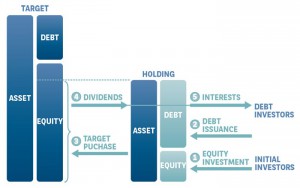
A technique used by investors to purchase a company using three different types of leverage:
- Legal leverage: The operation will be structured using a holding company that purchases shares of the target company. An investor that controls 50% of a holding company that owns 50% of the shares in the target company enables an investor to control the target while having paid for only 25% of its capital.
- Financial leverage: The holding company issues a large amount of debt to finance the takeover of a target company. Dividends of the target company that are paid to the holding company will then be used to service the debt.
- Fiscal leverage: Dividends generated by the target and paid to the holding company can be exempt of taxes. Furthermore, if certain criteria are met, the target’s income can be consolidated with the holding company’s income to potentially reduce global income taxes (if the holding’s income is negative). An LBO is a risky investment, which, in general, could last between three and seven years.
Libor
London interbank offer rate (LIBOR) is the average rate at which major banks in London would be charged to borrow funds in the interbank market. Libor rates are published on a daily basis for 10 currencies and 15 borrowing periods.
Life cycle fund
A fund in which asset allocation shifts gradually towards lower risk assets as time passes. Life cycle funds are appropriate for investors who want their investments to be automatically and progressively switched to more secure assets, for example as they near retirement.
Limit order
A limit order is an order to buy (sell) a given asset at a maximum (minimum) price. While enabling investors to control their executions, it limits their ability to fulfil orders. A limit order is opposed to a market order, where execution is achieved immediately in the market whatever the price.
Liquidity
This refers to how easily an asset can be flow, or how easily an asset can be converted into cash. Shares, which can be bought or sold rapidly on the stock market, are considered a highly liquid asset. Commercial property, on the other hand, is considered less liquid as it takes more time sell
Liquidity Management Tools
Liquidity management tools (LMTs) are instruments used by mutual fund managers to monitor a fund’s liquidity and treat all investors fairly. They are mainly used during extreme market conditions. See the prospectus for more information. There are different types of liquidity management tools, such as: Suspension of subscriptions, repurchases and redemptions, Redemption gates, extension of notice periods, redemption fees, swing pricing, dual pricing, anti-dilution levy, redemption in kind, side pockets.
- Suspension of subscriptions, repurchases and redemptions
This liquidity management tool temporarily disallows the subscription, repurchase and redemption of the fund’s units or shares. - Redemption gate
This liquidity management tool means is a temporary and partial restriction of the right of unit-holders or shareholders to redeem their units or shares, so that investors can only redeem a certain portion of their units or shares. - Extension of notice periods
The extension of notice periods is a liquidity management tool that extends the period of notice that unit-holders or shareholders must give to fund managers, beyond a minimum period which is appropriate to the fund, when redeeming their units or shares. - Redemption fee
This liquidity management tool is a fee, within a predetermined range that takes account of the cost of liquidity, that is paid to the fund by unit-holders or shareholders when redeeming units or shares, and that ensures that unit-holders or shareholders who remain in the fund are not unfairly disadvantaged. - Swing pricing
With this liquidity management mechanism the net asset value of the units or shares of an investment fund is adjusted by the application of a factor (“swing factor”) that reflects the cost of liquidity. - Dual pricing
With this liquidity management mechanism the subscription, repurchase and redemption prices of the units or shares of an investment fund are set by adjusting the net asset value per unit or share by a factor that reflects the cost of liquidity. - Anti-dilution levy
This liquidity management tool is a fee that is paid to the fund by a unit-holder or shareholder at the time of a subscription, repurchase or redemption of units or shares, that compensates the fund for the cost of liquidity incurred because of the size of that transaction, and that ensures that other unit-holders or shareholders are not unfairly disadvantaged. - Redemption in kind
With this liquidity management tool the fund transfers assets held by the fund, instead of cash, to meet redemption requests of unit-holders or shareholders. - Side pockets
With this liquidity management tool certain assets, whose economic or legal features have changed significantly or become uncertain due to exceptional circumstances, are separated from the main assets of the fund.
Liquidity risk
The risk of selling a security at a price significantly lower (higher) than its intrinsic value or being forced to buy at a much higher value due to a lack of market participants.
Loan
A loan is a debt instrument under which a lender provides money to a borrower who is obliged to pay interest payments and to repay the principal by a given date. Unlike bonds, loans are generally non-tradeable.
Long / short position
A long position is buying a security with the expectation that it will deliver a positive return if its value goes up and a negative return if its value falls. Conversely, a short position involves selling a borrowed security with the expectation of buying it back at a lower price to make a profit. However, if the security goes up in value, a short position will make a loss
Margin call
A margin call happens when an investor has borrowed money from a brokerage to buy securities (using margin), and the value of those securities falls below a certain level.
When this happens, the brokerage asks the investor to deposit more money or sell some of their investments to bring the account back up to the required minimum value. If the investor does not respond to the margin call, the brokerage has the right to sell some or all of the securities in the account to cover the borrowed amount.
Marked-to–market
Marked-to-market is a way of recording the price of a security for its market value. It records the price at which the security could actually be sold in the market at a certain time. Other accounting methodologies (fair value, historical cost) can also be used to value a security.
Maturity
See ‘Bond maturity’
Maximum drawdown
The Max Drawdown corresponds to the loss borne by an investor that would have bought at the highest and sold at the during on a given period.
Mergers and acquisitions (M&A)
A common phrase used to describe company consolidation trends.
A merger is when two firms join forces to create a new corporation.
An acquisition is the purchase of another company, which is absorbed into the buying firm.
Mid-price
The price at which shares in a fund are bought and sold by investors. It is mid-way between the real buying and selling prices based on the underlying assets held by a fund.
Modified duration
See ‘Duration’.
Money market fund
A segment of the financial markets for trading highly liquid financial instruments with short maturities. The money market is used by participants to borrow and lend in the short term – from several days to under one year. Examples of money market securities are certificates of deposits (CDs), US Treasury Bills, commercial paper and repurchase agreements (repos).
A money market fund is a fund investing in these markets.
Mortgage-backed securities (MBS)
Mortgage-backed securities are debt securities that pay a return based on the income generated by underlying assets such as the mortgage payments from residential homeowners.
Multi-asset
A fund that generally invests across a very wide spread of asset classes in order to diversify risk. As well as other funds multi-asset portfolios can invest in individual shares, bonds and commodities such as gold.
Murabaha
In Islamic finance, a murabaha is a contract that refers to the sale of an asset at a price that includes a profit level initially agreed by both parties of the contract. Therefore, this contract is valid if price, associated costs and profit margins are initially defined and stated at the time of the sale agreement.
Mutual Fund
An investment vehicle that is made up of a pool of funds collected from many investors for the purpose of investing in securities such as stocks, bonds, money market instruments and similar assets. Examples include OEICs, ETFs, SICAVs, unit trusts and investment trusts.
Net asset value (NAV)
Net Asset Value (NAV) is the total value of a mutual fund or an investment fund’s assets minus its liabilities, divided by the number of shares or units outstanding. It represents the per-share or per-unit value of the fund. Investors use the NAV to determine the price at which they can buy or sell shares in the fund, usually calculated at the end of each trading day. It provides a clear snapshot of the fund’s value at a given point in time.
Net exposure
The percentage value of the long positions less the percentage value of the short positions.
Net present value (NPV)
The net present value (NPV) of an instrument (bonds or equities) measures the sum of all its future cash flows’ present value. Each present value is calculated by discounting the cash flow expected value by the risk-free rate, plus a margin taking into account the risk associated with it. For instance, the NPV of a bond is the sum of all its coupons and principal repayments, discounted at the risk-free rate, plus the credit spread of the issuer.
Net zero
Balancing the amount of greenhouse gases released into the atmosphere with the amount removed, so that overall emissions are equal to zero. For investments, this means that the total greenhouse gases (like carbon dioxide) associated with the investments in a portfolio are zero. This can be achieved in two ways: 1) Investing in companies or projects that don’t produce greenhouse gases. 2) Offsetting any greenhouse gases produced by the investments through actions like buying carbon credits. The goal is to balance out emissions so that the overall impact on the environment is neutral. This concept is important for investors who want to support sustainability and reduce their carbon footprint through their investment choices.
Non-rated bonds
Bonds that are not rated by one of the ratings agencies. This maybe because they have not been submitted for a rating by the issuer or don’t meet the requirements of a rating.
Notional value
Commonly used in relation to a derivative, denoted the theoretical value of its underlying asset.
OEIC
An Open Ended Investment Company (OEIC) is a type of mutual fund where your money is pooled with that of other investors who choose to invest in the same fund. The value of your shares in an OEIC are directly related to the underlying value of its investments.
Ongoing charges
Ongoing charges are the fees and costs that a fund or investment account charges annually for managing and running the investment. These charges cover expenses such as fund management fees, administrative costs, and other operational expenses. It excludes transaction costs. Ongoing charges are expressed as a percentage and can be found in the fund’s documentation.
Open interest
The open interest represents the total volume of derivatives contracts (futures and options) that are still open (not settled) on a given underlying.
Open-ended fund
A fund that can issue or redeem shares according to the level of subscriptions and redemptions. See also ‘Closed-ended fund.
Option
Options are financial instruments that give their holders the right – but not the obligation – to buy or sell an asset at a predetermined price at or before a specified date. Buy options are also known as ‘call options’; sell options are also known as ‘put options’.
Option prices depend on the price of the underlying assets, the risk-free rate, the maturity and the expected volatility of the underlying asset.
Other expenses
Fees deduced from the fund’s asset incurred as part of the fund’s operations.
Over The Counter
Over the counter (OTC) transactions are bilateral trades that are dealt with outside of an organised market. In contrast with exchange trading, where transactions are standardised and reduce counterparty risk, OTCs are especially appropriate for non-standard transactions.
Passive investing
An investment strategy that mirrors the returns of a particular market index or benchmark as closely as possible. They do this by balancing the amount of each asset in a market they invest in with the value of the underlying assets. Companies that have a higher price will make up a larger proportion of a passive fund than lower-priced assets. Index funds are called as passively managed, rather than unmanaged, because each has a portfolio manager who is in charge of adjusting the fund’s holdings to replicate its benchmark.
Pay dates
The date that income is paid or accumulated.
Performance fee
A fee paid to an asset manager that generates positive returns above an agreed hurdle rate.
Portfolio turnover
The portion of a portfolio that is replaced on a yearly basis. Several methods of calculation exist. For example, as the ratio of the number of purchases or sales (whichever is the lesser) compared to the portfolio’s average asset value. It is usually expressed as a percentage.
Premium
Assets trade at a premium where the price is higher than the net asset value. For example, an investment trust’s shares can trade at a premium to the portfolio’s actual net worth, if it is in high demand
Principal
The amount of cash the bond-issuer owes to the bondholder at the bond’s maturity, not including any accrued interest. This is also referred to as “face value”, “par value” or “nominal value”.
Private Equity
Investments in companies that are not publicly traded on listed markets.
Put option
See ‘Option’.
Quantitative Easing (QE)
A technique that central banks use to encourage lending and spending increasing the amount of money in circulation. The main way of doing this is by purchasing government bonds from bond holders.
Rating agencies
See ‘Bond ratings’.
Redemption fee
This liquidity management tool is a fee, within a predetermined range that takes account of the cost of liquidity, that is paid to the fund by unit-holders or shareholders when redeeming units or shares, and that ensures that unit-holders or shareholders who remain in the fund are not unfairly disadvantaged.
Redemption gate
This liquidity management tool means is a temporary and partial restriction of the right of unit-holders or shareholders to redeem their units or shares, so that investors can only redeem a certain portion of their units or shares.
Redemption in kind
With this liquidity management tool the fund transfers assets held by the fund, instead of cash, to meet redemption requests of unit-holders or shareholders.
Repurchase agreement (REPO)
The combination of an asset sale with the commitment to repurchase it at a specified date and price. Similar to securitised lending, a REPO also enables the lender to have legal ownership of the security until the term of the transaction ends.
Rights issue
A rights issue occurs when a publicly listed company issues new shares to existing shareholders in a bid to raise money. Existing shareholders get the chance to buy the shares before anyone else. A company might do this if it wanted to raise money for expansion.
Securities
A broad terms for all varieties of investment instruments issued by a corporation, governments or other organisation. It includes equity and shares.
Securitisation
Securitisation is the process of creating liquid securities, such as ABS or CDO, from a pool of illiquid assets, mainly loan). Securitisation is usually combined with the mechanism of tranching to allow investors to choose their level of risk exposure. See also ‘Asset-backed security’.
Sensitivity
The Sensitivity addresses the potential pricing impact of a 1% interest change on a bond (or a bond portfolio).
Share
A unit of ownership in a company. Shares are often called ‘equity’ as they represent the value of a company divided into equal parts. In theory, if a company was wound up and all its interests and property were sold off then the outcome would be shared between all the shareholders, based on how many shares they hold.
You can find out more about investing shares here:
https://www.bnpparibas-am.com/en-gb/capabilities/individual-investors/investing-in-shares
Sharpe ratio
A measure of the performance of an investment adjusting for the amount of risk taken (compared to a risk-free investment). The higher the Sharpe ratio the better the return compared to the risk taken.
Short Interest ratio
A Short Interest ratio is the ratio between the numbers of shares sold short at a given time, to the total number of shares traded on a given day. Also known as the Days to Cover ratio, it gives an estimate for the number of days needed to cover short positions and is used by a certain category of investors to measure market sentiment toward a specific stock.
Short Interest Ratio = Short Interest / Average Daily Trading Volume
Short position
See ‘Long position’.
Short squeeze
A short squeeze is a market situation where the lack of supply of an underlying asset drives prices upwards. This situation is often amplified by short sales or short positions built through derivatives contracts. In these cases, the parties will start buying to cover their losses and, ultimately, will accept to buy the underlying at any price to avoid defaulting on their obligations (which has damaging consequences) pushing the prices higher. Short squeezes are often the result of market manipulation. A famous short squeeze occurred in October 2008 on Volkswagen stocks, which increased by more than 300% in two days.
SICAV
Société d’Investissement à Capital Variable. A type of open-ended fund widely used in Europe.
Side pockets
With this liquidity management tool certain assets, whose economic or legal features have changed significantly or become uncertain due to exceptional circumstances, are separated from the main assets of the fund.
SPE / SPV
A special purpose entity (SPE) or a special purpose vehicle (SPV) is a legal entity created by a company (the sponsor) to perform specific tasks.
SPEs/SPVs are widely used in securitisation to enable the issuance of securities backed by a pool of loans.
The key principles of an SPE/SPV are:
- Independence from its sponsor
- Bankruptcy remoteness
- True sale of assets from the sponsor
- Thin capitalisation
- Self-sustained
- Administrative functions performed by a trustee
Spot price
A spot price is a price settled for the delivery of an asset occurring two trading days after the trade date. The spot price is the opposite of the forward price.
Spread
The difference between the bid and the ask price of a single security. It can also refer to the difference in price between securities. In fixed income investing, it describes the difference in yield between different types of bond: see ‘Credit spread’.
Stewardship
The responsible management of investments with the goal of enhancing long-term value through promoting sustainable practices. It involves engaging with companies to encourage better environmental, social, and governance (ESG) practices, voting on shareholder resolutions, and monitoring the performance of investments. The aim is to ensure that investments align with the values and interests of investors and contribute to a more sustainable future.
Straddle
A long straddle strategy involves the purchase of a put and a call at the same strike. A buyer of a straddle will thus benefit from a large change in the underlying price, either upwards or downwards.

Strangle
A long strangle strategy involves the purchase of a put and the purchase of a call at the higher strike price. The buyer of a strangle will thus benefit from a large change in the underlying price, either upwards or downwards. Less costly than a straddle, a strangle however, requires a larger price variation to be profitable.
Structured Investment Fund
A fund that combines fixed income securities and equities to reduce the impact of market downturns while still providing the potential for capital appreciation.
Sub-investment graded bonds
See ‘Bonds’.
Subordinated bond
A bond that ranks lower in priority compared to other bonds issued by the same issuer. This means that if the issuer faces financial difficulties or goes bankrupt, subordinated bondholders are paid after senior bondholders have been compensated.
Sukuk
In Islamic finance, sukuk are Islamic securities traded in the form of documents or certificates that represent the value of these assets. Often described as Islamic bonds, sukuk can technically refer to securities, notes, paper or certificates, with the features of liquidity and tradability
Suspension of subscriptions, repurchases and redemptions
This liquidity management tool temporarily disallows the subscription, repurchase and redemption of the fund’s units or shares.
Sustainability Disclosure Regulations (SDR)
Rules set out by the Financial Conduct Authority in 2024 that require financial firms to provide clear and consistent information to investors about how they incorporate sustainability factors in their investments. This means that firms must explain how they consider sustainability factors when making investment decisions and report on the sustainability performance of their investments. The aim is to help investors make informed decisions and promote responsible investing. You can find out more about SDR here: https://www.bnpparibas-am.com/en-gb/capabilities/investing-sustainably/sdr/
Sustainability Disclosure Regulations (SDR) Labels
The SDR measures include a labelling system for funds to help investors understand the sustainability impact of their investments. To qualify for a label a fund must
- Have a specific sustainable objective or promote environmental or social characteristics as its main goal.
- Have a way to measure progress towards achieving its objective.
- Report regularly on these measurements for investors
- Meet specific criteria set out by the FCA, depending on the label.
Funds that don’t meet these standards won’t qualify for labels, even if the fund manager considers sustainability factors when making investment decisions for these funds.
The labels are:
- Sustainable impact – invests in companies providing solutions to sustainability problems
- Sustainable improver – invests in companies or projects that may not be sustainable now but which are making measurable improvements in their sustainability performance.
- Sustainable focus – invests in companies or projects that have a strong sustainability focus, with sustainability considerations integrated into the fund’s investment decision-making process.
- Mixed Goals – Invests in a mix of assets that are already sustainable, have the potential to improve their sustainability over time, and/or aim to provide solutions to sustainability problems.
Funds that have SDR labels – and some funds that have sustainability characteristics but don’t qualify for a label – now have special reports outlining how sustainability considerations are included in their investment strategies. BNP Paribas Asset Management refers to these as “Sustainability Disclosure Requirements – Consumer Facing Disclosure”.
Find out more about SDR labels at BNP Paribas here
Swap
A swap is an arrangement between two entities who agree to exchange streams of cash flows on different dates with a specified term. Cash flows can be certain or optional, amounts can be known in advance or variable, payment currencies can be multiple. Examples of swaps: Interest rate swap: floating rate is exchanged against a predetermined rate; Credit default swap (CDS): a protection from a credit event of a specific company (or country) is contracted against a stream of fixed payment (see credit default swap definition for further details); Cross currency swap: exchange of principals and interests in two different currencies; Inflation swap: inflation is exchanged against a predetermined rate.
Swaption
A swaption is an option to enter into a swap transaction at a specified date and a pre-defined price. For example, a 5-year, 3% fixed receiver swaption, maturity June 2014 refers to an option where the holder would have the right to receive 3% against payment of floating rate, for 5 years starting in June 2014.
Swing pricing
With this liquidity management mechanism the net asset value of the units or shares of an investment fund is adjusted by the application of a factor (“swing factor”) that reflects the cost of liquidity.
Target return fund
Funds that seek to achieve a defined return over a particular period, regardless of market movements.
Technical analysis
A way to evaluate stocks or other investments by looking at their past price movements and trading volume. Investors use charts and technical tools to spot patterns and trends, helping them decide when to buy or sell. It focuses on what the market is doing now and in the recent past, rather than the company’s financial health.
Thematic investing
Thematic investing strategies seek to invest in social, economic or technological trends that are expected to provide positive investment returns. Examples include areas such as healthcare innovation, clean energy, consumers and digital transformation, although there are many potential themes. Thematic investors look to invest in stock that have the best potential to benefit from that theme.
Top-down
An investment approach that bases investment decisions on the wider macro-economic backdrop before considering the fundamentals of individual companies or issuers. See also ‘Bottom-up’.
Total expense ratio (TER)
The annual costs of running a fund summarised into a single figure. It includes things like management fees, administrative costs, and other expenses, making it easier to compare the fees charged to different funds.
Total return
The gain or loss in value of any investment plus any income generated over a given period. It contrasts with price return, which only shows the change in value.
Tracker fund
A type of passive investment fund that that mirrors, or tracks, the trajectory of a particular market or index, such as the FTSE 100. See also ‘Passive investing’.
Tracking error
Tracking error measures how closely a fund’s performance matches the performance of its benchmark index. If a fund has a low tracking error, it means it’s doing a good job of copying the index. A high tracking error indicates the fund’s returns are diverging more from the index.
A low tracking error is desirable if you want your fund to mirror the index’s performance. A higher tracking error could indicate that a fund manager is taking different risks from the index as part of an active management approach or that the fund has higher costs, leading to performance that can be quite different from the benchmark.
Tranching
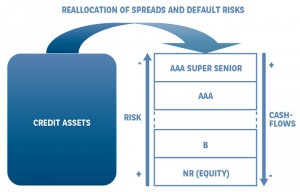
Tranching is a mechanism widely used in securitisation to reallocate the risk/return profile of a portfolio into different slices. One of the key goals of this process is to provide credit enhancement to newly-created senior tranches (AAA, low credit risk). Intermediate tranches (mezzanine) and subordinated tranches with high credit risk (equity) are then also available. The two main principles of tranching are:
- Reallocation of credit default risks of the asset pool from equity to senior tranches.
- Reallocation of cash-flows generated by the asset pool from senior to equity tranches.
Trustee
A trustee is a legal entity that performs tasks on behalf of a beneficiary. In the context of fund managers, a trustee is a trusted organization or individual responsible for overseeing the mutual fund. Their main job is to protect your interests and ensure the fund is managed fairly, transparently, and according to the rules.
UCITS
Stands for ‘Undertakings for Collective Investment in Transferable Securities’, which describes a category of investment funds. UCITS funds can be marketed in all countries that are a part of the European Union, provided that the fund and fund managers are registered within the European Union.
Unit trust
A type of open-ended pooled investment or mutual fund, where investors can buy units. The unit trust manager creates units for new investors and cancels them when they are redeemed. See also ‘Open-ended fund’
United Nations Sustainable Development Goals (SDGs
The SDGs are 17 global goals set by the United Nations to address important issues like poverty, inequality, climate change, and health by 2030. They aim to make the world a better, more sustainable place for everyone.
Many companies now focus on sustainability and social responsibility, aligning their goals with the SDGs. Investing in such companies, could help support positive change while also aiming for good financial returns.
The 17 SDGs are:
1. No Poverty
2. Zero Hunger
3. Good Health and Well-being
4. Quality Education
5. Gender Equality
6. Clean Water and Sanitation
7. Affordable and Clean Energy
8. Decent Work and Economic Growth
9. Industry, Innovation and Infrastructure
10. Reduced Inequalities
11. Sustainable Cities and Communities
12. Responsible Consumption and Production
13. Climate Action
14. Life Below Water
15. Life on Land
16. Peace, Justice and Strong Institutions
17. Partnerships for the Goals.
For more information about the UN Sustainable Development Goals, please refer to: https://sdgs.un.org/goals.
Valuation point
The date and time of day when funds are valued and their shares or units priced.
VaR
VaR is a way to estimate how much you could potentially lose on your investment over a certain period, with a given level of confidence. It helps investors understand and manage the risk of their investments by showing how bad things could get in the worst-case scenario, within a certain probability.
Value investing
Value Investing focuses on investing in stocks that are perceived as trading below fair valuation for reasons unrelated to their growth profile. Typically, value stocks show low valuation ratios (for example price-to-earnings or price-to-book ratios) and high dividend yield. Value sectors include banking, telecoms and utilities. See also .Growth investing’.
Volatility
Volatility measures how often and by how much the price of an asset changes, typically expressed as the standard deviation of returns over a certain period. High volatility is characterised by more frequent and larger swings in value, lower volatility by lower and less frequent change. Essentially, it is a measure of risk.
Some assets are inherently more volatile than others. Shares, for example, have historically been more volatile than bonds. Volatility also tends to rise during periods of uncertainty – prices can vary sharply as investors try to account for fast-moving events in their analysis.
Volume-weighted average price (VWAP)
The volume-weighted average price (VWAP) is the ratio of the total value traded to the total volume traded during a given period. Lots of brokers are assessed for their capacity to execute orders at prices which are equal or better than the VWAP.
Warrant
A warrant is a security offering the right (but not the obligation) to purchase underlying stocks of an issuing company at a specified price and date. Unlike call options, warrants are issued by the underlying entity itself.
Waterfall
A waterfall represents a set of rules which define the prioritisation of payments of an asset. According to a waterfall, subordinated investors start receiving principal only when senior investors are fully reimbursed.
Weighted Average Carbon Intensity (WACI)
A way to measure a portfolio’s exposure to companies’ carbon emissions. It is based on the emissions of the issuers of shares and bonds held in the portfolio measured in tons of carbon dioxide emissions per US$1m of revenue. This figure is then adjusted according to the for the size of the holding so that companies where there is a large investment count more towards the final figure than smaller investments.
The WACI calculation takes into account carbon emissions from sources controlled by an issuer (Scope 1 emissions) and indirect carbon emissions from the production of electricity, heat or steam consumed by an issuer (Scope 2 emissions). Indirect emissions in the value chain of an issuer, for example from suppliers, (Scope 3 emissions) are not included because data is either not yet available for many issuers or not reliable enough to use as a basis for investment decisions.
Weighted average delta
Refers to the overall delta of a collection of derivatives based on the delta of each individual derivative and their respective ‘weight’ or size in the collections as a whole.
Weighted average life (WAL)
The weighted average life (WAL) of a securitised product measures the time taken for half the security’s principal to be repaid. The weighted average life is the most common figure to assess the maturity of a securitised product.
West Texas Intermediate (WTI)
West Texas Intermediate (WTI) is a sweet light crude oil (lighter than Brent Crude) used as the underlying for oil futures contracts traded in the New York Mercantile Exchange.
Withholding tax
A tax levied on income (interest and dividends) from securities owned by a non-resident
XD dates (ex-dividend)
The dates by which you have to hold shares in a fund in order to be entitled to the next income payment from that fund.
Yield
A measure of return from interest or dividend income expressed as a percentage of an asset’s price. See also ‘Bond yield’ and ‘Dividend Yield’
Yield Curve
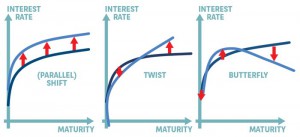
A graph that plots the yield of equally rated bonds with different maturity dates. It helps investors understand how the market views future interest rates and economic outlook.
The yield curve normally slopes up, with long-term yields higher than short term yields. This is because investors expect a higher premium for locking their money in longer.
In rare cases, the curve can be negatively sloped, often referred to as an inverted curve, with short-term bonds offering higher yields. This is considered a sign of a potential impending recession because investors are expecting lower central bank interest rates and are willing to pay more to lock in longer-term bonds.
Yield to call
The yield of a bond if you were to buy and hold it until its call date. This yield is valid only if the bond is called prior to maturity
Yield to Maturity (YTM)
The rate of return an investor would receive if a bond is held to its maturity date. This includes all coupon interest and principal payments and is expressed as an annual percentage rate. It’s also known as the internal rate of return.
Yield to Worst (YTW)
This is the lowest potential yield a corporate bond holder can expect. If a bond is callable, the rate of return is calculated to each call date. The YTW is then the lowest of either the yield to maturity or yield to call. Because YTW is the most conservative way to look at a bond, it is often used in high yield investments, where bonds are frequently callable. See ‘Callable bonds’
Z-spread
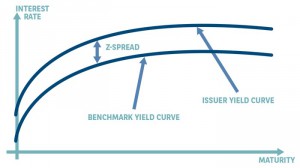
The z-spread measures the flat spread over a benchmark yield curve that investors require to lend money to an issuer. The z-spread is often used to compare bonds from different maturities and different currencies.
Zero Coupon Bond
A bond that doesn’t pay regular coupon payments but is traded at a discount to its face value. The principal payment on maturity will be higher than the investor paid, compensating them for the loss of interest payments. Because they offer the entire payment at maturity, zero coupon bonds tend to fluctuate in price much more than coupon bonds
Socially responsible investment (SRI)
A socially responsible investment (SRI) is an investment in companies based on social and environmental criteria. Socially responsible investing favours companies engaging in environmental sustainability and clean energy for example, while avoiding companies with a poor environmental record or companies promoting addictive substances such as alcohol or tobacco.